
Bone and joint procedures · En español
Total knee replacement (total knee arthroplasty)
A typical case runs 7 steps over 2 visits. Each step names its published source.
The steps, visit by visit
Visit 1 of 2
Steps 1 to 6Anesthesia
An anesthesiologist gives either general anesthesia, which means the patient sleeps through the operation, or regional anesthesia, which numbs the body from the waist down. Pain is typically not felt during the surgery.1
Opening the knee
The surgeon makes a cut down the front of the knee and moves the kneecap to the side to reach the knee joint behind it. The lower end of the thighbone and the upper end of the shinbone are the parts replaced in a total knee replacement.2
Preparing the bone
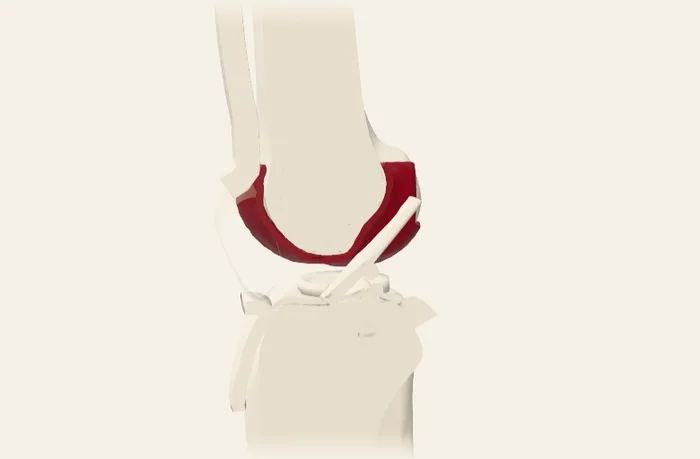
The surgeon removes the damaged cartilage surfaces at the ends of the femur and tibia, along with a small amount of underlying bone. The ends are shaped so the new parts fit them closely.3
Fitting the metal implants
Metal parts re-create the joint surface on the end of the femur and the top of the tibia. They may be cemented or press-fit into the bone, so a knee replacement is often described as resurfacing.3
Kneecap and plastic spacer
The underside of the kneecap may be resurfaced with a plastic button, though some surgeons skip this. A medical-grade plastic spacer goes between the metal parts to create a smooth gliding surface.3
Closing up
The kneecap is put back into place. The surgeon closes the cut on the knee using stitches or clips and covers it with a dressing and bandage. The operation usually takes about 1 to 2 hours.2
Visit 2 of 2
Step 7Recovery and rehab
Patients work with a physical therapist for up to a few months to start bending the knee and walking safely, and do home exercises. Most people resume usual activities in about six weeks, and full recovery usually takes around a year.1
Questions to ask your orthopedic surgeon
- The typical case takes 2 visits. How many would I need, and what happens at each one?
- What are my other options, including waiting, and what happens if I wait?
- When can I walk, drive and go back to work?
- What will it cost me, and will my insurance cover it? Ask which billing codes apply (the typical case uses 27447).
- How many of these have you done, and who would do mine?
Sources
- Cleveland Clinic, “Knee replacement (arthroplasty)”. my.clevelandclinic.org/health/treatments/8512-knee-replacement. Read 25 November 2026.
- NHS, “How a knee replacement is done”. www.nhs.uk/tests-and-treatments/knee-replacement/how-its-done/. Read 25 November 2026.
- AAOS OrthoInfo, “Total knee replacement”. orthoinfo.aaos.org/en/treatment/total-knee-replacement/. Read 25 November 2026.